

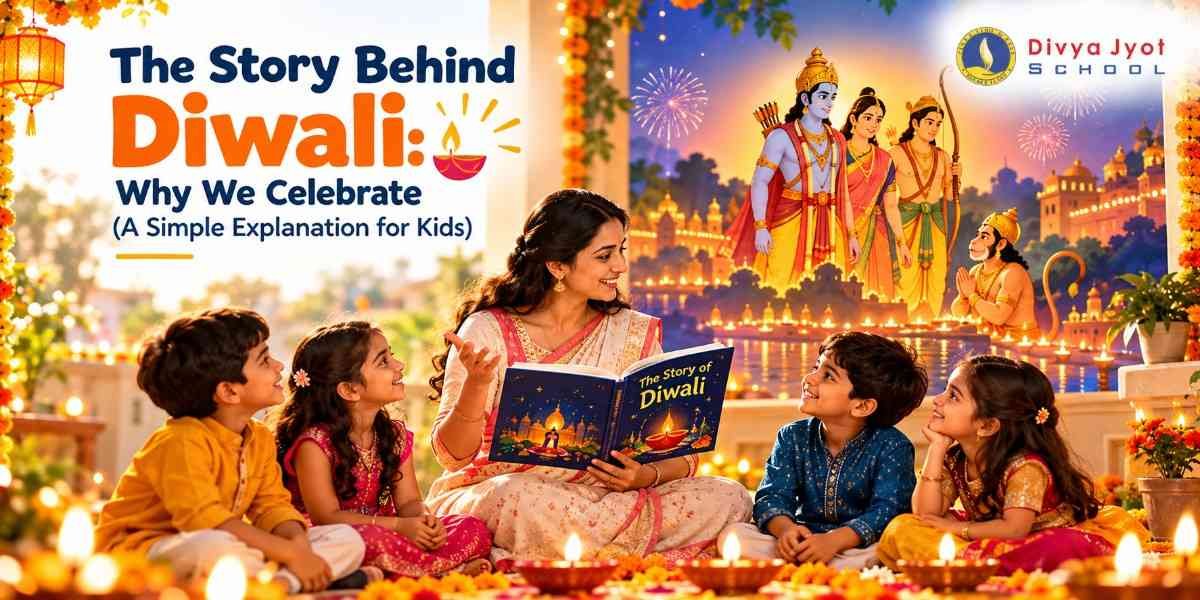
Have you ever wondered what is the reason behind small lights being lit in houses during Diwali? Why do families colour in patterns around the doors, and exchange boxes of sweets? Every festival has a meaning and Diwali is a festival with great stories to share.
This is a Diwali story for children about a homecoming when people come back from their journeys to their homes. But this festival is also a reminder to do something every day: be kind, courageous and caring make others happy. Let’s learn the story of Diwali, learn the traditions and understand how to make it meaningful for the children.
What Is Diwali?
Diwali is also known as Deepavali festival of lights. Deepavali means ‘a row of lamps’. Diyas, small lamps known for their association with the festival, provide a familiar glow to the festival.
Families, lights, decorations, prayers, food and visits of loved ones are part of the celebration. There are some customs that are not universal. In various areas and within each community there are various stories and traditions.
There’s a lot of common ground in many of the celebrations. The word is light, which symbolizes hope and goodness. Consider how a small light helps you to see in a dark room. Likewise, with a good plan in place, a person can find happiness on a bad day.
The Diwali Story for Kids: Rama’s Return to Ayodhya
One of the popular Hindu customs is to associate Diwali festival with the return of Lord Rama to Ayodhya. This story comes from the Ramayana, an ancient Indian epic a long story about an important journey.
A Long Journey Away from Home
Rama was one of Ayodhya’s princes. He left his kingdom for 14 years in order to keep a promise made by his dad. He brought his wife, Sita and his brother Lakshmana. Life in the woods was very different from life in a palace. There were difficulties and they were responsible for supporting each other. To be gone for so long from their friends and family, and comfort of home. This helps us to understand why their return was so special.
Friends, Courage and Assistance
During the period they were away, Ravana, who was the king of Lanka, kidnapped Sita. Rama ventured out to save her life. Rama and his friends, such as Lakshmana, Hanuman and others assisted him and they both underwent a lot of difficulties which they succeeded in conquering. Finally, Ravana was defeated by Rama and Sita was liberated. It is an important lesson that children should learn from this part of the tale: It requires courage to ask for assistance. Friends are able to achieve more when they work as a team.
A Celebration Lighted by Lanterns
After the end of the fourteen years, Rama, Sita and Lakshmana returned to Ayodhya. This tradition was to welcome them by lighting rows of lamps. The glowing Diyas were a symbol of their joy during the Homecoming event. Many families will recall this welcome when they light up lamps during Diwali. The lights are a message of hope and joy; the triumph of good over evil.
Why We Celebrate Diwali: More Than One Story
After all, it’s not only Rama’s homecoming that is a significant part of Diwali’s story. This will help children to appreciate the diversity of traditions of friends and neighbours.
Krishna and Narakasura
In Hinduism, especially in southern India, there are some traditions celebrating the defeat of Krishna over Narakasura. This story’s main idea is to defeat the cruel and to promote peace.
Prayers to Goddess Lakshmi
The Hindu community dresses up as Goddess Lakshmi during Diwali festival. She is believed to be the goddess of happiness, good health, and wealth. A great chance for kids to reflect on the meaning of being thankful. There are all those things to be thankful for, as well as material things, such as the people we love around us, learning, and our home, where we are welcomed.
Jain and Sikh Observances
For Jains, Diwali is a day that marks the spiritual awakening or liberation from nirvana of Lord Mahavira. Around this time, Sikhs celebrate the Bandi Chhor Divas in remembrance of Guru Hargobind’s release from prison. It is used with religious significance and meaning. A question to pose to a friend is: “What are you remembering at this festival?” When we hear the answer, we might learn something new.
What Do Diwali Traditions Mean?
Decorations are the first things that the children notice. Explain familiar customs in terms that they can understand so that a connection is made between celebrating and significance.
Lighting Diyas
Diyas are small (often clay) oil lamps. Their light is often associated with hope and good. Perhaps a diya could be a reminder to do something nice: Like inviting someone to play a game, telling the truth, comforting a friend. They are very small things but might mean a lot to someone else.
Making Rangoli
Rangoli Objects carved into the ground, usually in front of doors. Coloured powders, flowers or other materials are acceptable for use by the families. Creating a pattern with someone else can be a fun creative endeavor. Children will learn about shapes, colours and symmetry, and help put the area together to make a positive place.
Sharing Sweets and Spending Time Together
A characteristic of Diwali is the exchange of food between friends and family as well as greeting each other. The ingenious thing is how you remember other people. It can be as special as a card made by hand, a friendly greeting or just spending time with a grandparent. Cleaning and decorating the house is another method used by families in taking care of their homes. The children participate in doing simple things like arranging the books, and ordering for decoration.
What Lessons can Children Learn on Diwali?
It becomes easy to understand the significance of Diwali when the ideas are applied to the real world.
Kindness Begins with You
There’s no need to wait for a festival to come along and help. Include a classmate in your group, share, when appropriate, thanking those who have supported you.
Reflect on the question, “Who can make someone smile today?”
Courage Includes Doing the Right Thing
Not all selections are available. Making the bold move of accepting their mistake or voicing out what is in their mind even when one is excluded may prove to be hard. It is critical that they will make the first move and inform an adult who can help them. They don’t have to solve everything on their own.
Teamwork Makes a Difference
Parents and teachers may engage in a discussion of cooperation using the story of Rama’s trip. Cooperation means that in school, while working on a collective assignment, one listens to others, takes turns and acknowledges the contribution of others. The team works well when all members participate.
Respect Helps Us Learn
Christmas may be celebrated in a different fashion now to the way your friend celebrates it. Some families pray, some visit relatives and some celebrate quietly. Be curious but not everyone have to have the same customs. Do ask questions, listen well, and remember that some kids may not observe Diwali.
Simple Diwali Activities for Kids
These activities will help kids experience Diwali in different ways, from listening to stories to drawing and discussion.
Create a Three-Picture Story
Split up a sheet of paper into three parts:
- Rama, Sita, and Lakshman set out from Ayodhya.
- Rama receives help during his journey.
- They return to a welcome of glowing lamps.
Add one sentence beneath each picture. Younger children can explain their drawings aloud instead.
Create a Kindness Diya
Draw & cut a paper diya. Write one action in it, for example, “I will help tidy our classroom” or “I will invite someone to play. Display the paper diyas together. After some days talk with children about what they did and how they helped.
Ask About a Family Tradition
Ask a parent, grandparent or other trusted adult to tell about a festival memory. Challenge: “What were your favorite things when you were a kid? What is important to you about the tradition? If a child’s family does not celebrate Diwali, they can share a special tradition from another time.
Design a Reusable Rangoli
Design a pattern with paper shapes, fabric pieces or craft materials that can be used again. Select a main shape and elaborate on it. Then, explain the colours and shapes that you employed. Store components for future use in making other designs.
Thoughtful Way of Celebrating
We should celebrate but we have to treat others with respect. Children can use decorations such as those from paper, non-electrical lighting, home-made cards and some quiet games. Fireworks are never required while celebrating Diwali. Adults have to use fire, matches and electrical lights. Non-electric diyas or battery-powered lights have to be used to help children arrange them. Just consider that there are neighbors who need silence, pets who are afraid of noise, and people who need rest. Do not forget that there are some health problems and food allergies with people around us.
Learning Through Festivals at Divya Jyot School
Festival stories can motivate reading, discussion, art and reflection. A child can repeat a story, describe family traditions or a service they provided to someone. Divya Jyot School describes an educational approach that combines academics with values, creativity, and holistic development. Parents can explore the school’s approach to value-based education to learn more about its vision.