

Screens are now a normal part of childhood. Children use computers for schoolwork, tablets for learning activities, smartphones to communicate, and televisions or gaming devices for entertainment. Digital tools can make learning more engaging and help children explore ideas beyond the classroom. However, when screen use becomes excessive or unbalanced, it can affect sleep, physical activity, attention, family time, and overall well-being.
The goal is not to remove screens from a child’s life. Instead, children need to learn how to use technology in a healthy and responsible way.
We believe that education should prepare children not only for academic success but also for the changing world around them. Developing healthy digital habits is an important part of this journey. When children learn to balance technology with physical activity, creativity, social interaction, reading, and rest, they develop habits that can support them throughout their education and future careers.
Why Healthy Screen-Time Habits Matter
Technology has become an important part of modern education. Students may use digital classrooms, educational videos, online research, interactive learning platforms, and other resources to understand difficult concepts.
At the same time, children may spend additional hours watching videos, playing games, browsing social media, or using entertainment apps.
When screen use is not managed properly, children may start spending less time being physically active or interacting with family and friends. Late-night screen use can also make it harder for children to maintain a healthy sleep routine.
Healthy screen-time habits help children understand that technology is a tool not something that needs to occupy every free moment of the day.
The focus should be on balance, purpose, and quality rather than simply counting every minute a child spends looking at a screen.
Create a Consistent Screen-Time Routine
Children generally respond well to clear routines. Instead of allowing unlimited and unpredictable screen use, parents can create simple rules around when technology can be used.
For example, screen time can be planned around schoolwork, physical activity, meals, family time, reading, and sleep.
A child might complete homework first, spend some time outdoors, have dinner with the family, and then enjoy a limited period of entertainment.
The exact routine can vary depending on the child’s age, school schedule, activities, and family circumstances. What matters most is consistency.
A predictable routine also helps children understand that screen time is one part of their day not the center of it.
Separate Educational Screen Time From Entertainment
Not all screen time serves the same purpose.
A child researching a science project, attending an online learning session, creating a presentation, or practicing a language is using technology differently from a child spending an hour watching random videos.
Parents can help children understand this difference.
Educational technology can encourage curiosity, research skills, creativity, problem-solving, and independent learning. Entertainment can also be enjoyable and appropriate, but it should have its place within a balanced daily routine.
This distinction is particularly important as schools increasingly use technology to support modern education for career success. Children need to become comfortable with digital tools while also learning when and how to use them responsibly.
Encourage Regular Breaks
Children should not remain in front of a screen continuously for long periods.
Encourage them to stand up, stretch, walk around, look away from the screen, drink water, or participate in another activity. Short breaks can make digital learning more comfortable and give children an opportunity to reset their attention.
For schoolwork, parents can encourage children to divide longer assignments into manageable sections rather than sitting continuously at a computer.
A simple routine can be:
Learn – Take a break – Move – Return to learning
This approach can make study sessions feel less tiring while encouraging children to develop healthy working habits.
Keep Screens Away During Family Meals
Family meals provide an opportunity for conversation and connection. Phones, tablets, and other devices can easily distract children and adults from these moments.
Try making mealtimes screen-free whenever possible.
Instead of watching videos or checking notifications, families can talk about their day, discuss school activities, share stories, or simply enjoy their meal together.
These small conversations can help children develop communication skills and confidence skills that are valuable both inside and outside the classroom.
Protect Sleep From Late-Night Screen Use
Sleep plays an important role in a child’s learning, mood, memory, and physical development.
Using phones, tablets, gaming devices, or computers immediately before bedtime can make it harder for some children to settle into a consistent sleep routine.
Parents can create a simple rule that entertainment screens are switched off before bedtime. Devices can also be kept outside the bedroom when practical.
A calm bedtime routine might include reading a physical book, preparing school materials for the next day, talking with family, or simply relaxing.
Good sleep habits are just as important as good study habits.
Make Time for Outdoor Play and Physical Activity
Technology should never completely replace movement.
Children need opportunities to run, play sports, walk, cycle, explore, and simply spend time outdoors. Physical activity supports overall health and also gives children a break from sitting and looking at screens.
Parents can encourage children to participate in activities they genuinely enjoy. This could include football, swimming, dancing, cycling, athletics, or simply playing outside with friends.
A balanced childhood includes both digital experiences and real-world experiences.
Encourage Reading Beyond the Screen
Digital content can be useful, but children should also have opportunities to read books, magazines, stories, and other age-appropriate printed material.
Reading helps children build vocabulary, comprehension, imagination, and communication skills.
Parents can create a small reading routine at home. Even 15 to 20 minutes of reading each day can become a valuable habit over time.
Schools can support this by encouraging students to explore different types of books and develop curiosity beyond their textbooks.
Teach Children to Use Technology Responsibly
Managing screen time is not only about limiting usage. Children also need to understand how to behave responsibly in a digital environment.
Parents and educators can talk to children about:
- Protecting personal information
- Creating strong passwords
- Being respectful online
- Avoiding communication with unknown people
- Checking information before believing or sharing it
- Reporting inappropriate content
- Understanding that online actions can have real-world consequences
These are important elements of digital literacy.
As technology becomes increasingly connected to education and employment, responsible technology use will become an increasingly valuable life skill.
Help Children Become Active, Not Passive, Technology Users
There is a major difference between simply consuming digital content and using technology to create something.
Instead of only watching videos, children can be encouraged to make presentations, create digital artwork, write stories, research topics, learn basic coding, record educational projects, or develop multimedia assignments.
This type of technology use can support creativity and problem-solving.
It also connects naturally with the idea of Future Skills for Students. Skills such as creativity, collaboration, communication, critical thinking, digital literacy, and problem-solving can help students adapt to new learning environments and future workplaces.
Encourage Real-World Learning
Technology can open the door to information, but children also need experiences outside the screen.
Cooking with parents, visiting a museum, conducting a simple science experiment, gardening, playing a sport, helping with household responsibilities, or exploring nature can all become learning experiences.
These activities teach children how knowledge works in real situations.
A strong educational environment combines classroom learning, technology, practical experiences, creativity, and social development.
This is an important part of Future-Ready Education preparing students to apply what they learn rather than simply memorize information.
Set an Example as Parents and Teachers
Children often learn habits by observing adults.
If parents constantly check their phones during conversations, meals, or family activities, children may find it difficult to understand why their own screen use should be limited.
Adults can model healthy digital behavior by putting devices away during important conversations, taking technology breaks, and maintaining screen-free family activities.
Teachers can also encourage responsible technology use by showing students how digital tools can support learning without becoming a distraction.
When children see healthy habits consistently practiced around them, those habits become easier to adopt.
Focus on Quality, Not Just Quantity
A common mistake is to think that every minute of screen time has the same impact.
It does not.
A child creating a presentation, learning a new skill, talking to a teacher, researching a school project, and watching random entertainment content are having very different digital experiences.
Parents should consider questions such as:
What is my child doing online?
Is the activity appropriate for their age?
Does it support learning, creativity, communication, or relaxation?
Is screen use affecting sleep, exercise, schoolwork, or family relationships?
These questions can provide a more useful picture than simply counting screen minutes.
Building Digital Balance Through Modern Education
Schools have an important role to play in helping children develop a healthy relationship with technology.
At Divya Jyot School, education can be viewed as more than completing textbooks and preparing for examinations. Students need opportunities to develop academic knowledge alongside communication, creativity, critical thinking, collaboration, digital awareness, and practical problem-solving.
These skills are increasingly relevant to the changing world of work.
A Future-Ready Education approach helps students understand how to learn, adapt, communicate, and use technology responsibly. It does not mean replacing traditional learning with screens. Instead, it means using technology thoughtfully alongside strong fundamentals.
Children still need books, teachers, conversations, physical activities, creative expression, and real-world experiences.
Technology works best when it strengthens these experiences rather than replacing them.
Preparing Children for Future Skills and Career Success
The workplace of tomorrow will continue to evolve. New technologies, digital tools, and ways of working are already changing how people communicate and solve problems.
This makes Future Skills for Students increasingly important.
Children can begin developing these skills through everyday learning experiences. A group project can teach collaboration. A research assignment can develop critical thinking. A presentation can improve communication. A coding activity can encourage problem-solving. Creative projects can build confidence and innovation.
Healthy screen habits support this development because children learn to use technology intentionally rather than automatically.
This balance can contribute to modern education for career success, where students are prepared not only to pass examinations but also to continue learning and adapt to new challenges.
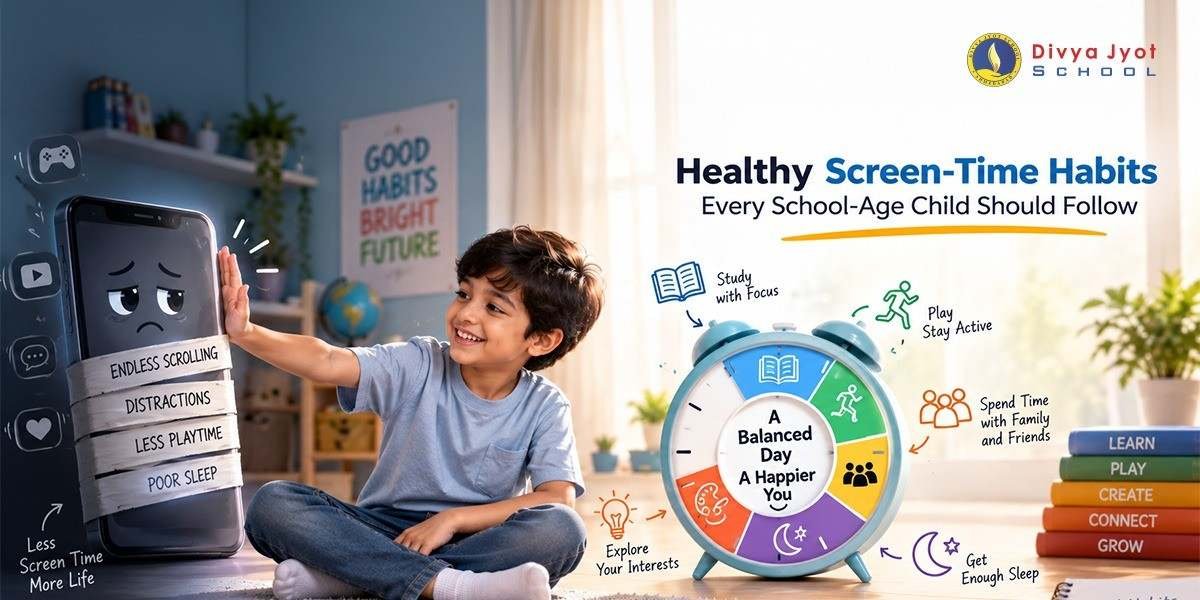
A Simple Daily Digital Balance for Children
Families do not need a complicated system to encourage healthy technology habits.
A simple daily routine might include:
Morning: Get ready for school without unnecessary screen distractions.
School hours: Use digital devices when they support classroom learning.
After school: Take time for food, rest, outdoor play, sports, or hobbies.
Homework: Use screens for educational activities and assignments when required.
Evening: Spend time with family, read, play, or participate in non-screen activities.
Before bed: Switch off entertainment devices and follow a relaxing bedtime routine.
The exact schedule will depend on each child and family. The important principle is to create a healthy balance between digital activities and other parts of childhood.
Final Thoughts
Screens are not the enemy. They are simply one part of modern childhood.
The real goal is to help children understand when technology is useful, when it is time to step away, and how digital tools can be used responsibly. With consistent routines, regular breaks, physical activity, quality sleep, family interaction, reading, and purposeful technology use, children can develop healthier relationships with screens.
At Divya Jyot School, the focus on education can extend beyond today’s classroom requirements toward preparing students for tomorrow. By combining strong academic foundations with digital awareness, creativity, communication, critical thinking, and other Future Skills for Students, children can become more prepared for an increasingly connected world.
Healthy screen-time habits are a small but meaningful part of that journey. When children learn to balance technology with real-world learning and human connection, they are not simply becoming better technology users they are developing habits that can support lifelong learning and future success.